

Swiss customs in 2025: from e-dec to Passar with SAP GTS


Wolfgang Baer

Wolfgang Baer

Senior Manager, Global Trade Automation, PwC Switzerland

Switzerland’s customs IT landscape is in the midst of a major transformation. The long-standing e-dec platform is giving way to Passar, the Federal Office for Customs and Border Security’s modernised system designed to streamline import, export and transit processes. At the same time, SAP Global Trade Services, SAP’s solution for industry to manage customs processes, free trade agreements, sanctions and export controls, is moving from SAP GTS 11 to SAP GTS Edition for HANA.

From e-dec to Passar

Passar is part of the larger DaziT initiative, which aims to digitise and simplify customs procedures across Switzerland. Although its rollout has experienced delays, the system promises faster declaration times, improved data quality and better collaboration between businesses and customs authorities. By early 2026, most core functions of e-dec should be replaced by Passar, making it essential for companies to prepare for this change.

Passar 1.0 (exports) has been live since early 2024, and is mandatory for Swiss authorised consignors clearing their goods using NCTS Phase 5. As for the others, they have until the end of 2025 to upgrade, when e-dec Export will be decommissioned. As for Passar 2.0 (imports), a transition period from e-dec Import is predicted to last from Q2 2026 to Q1 2027 (one year).
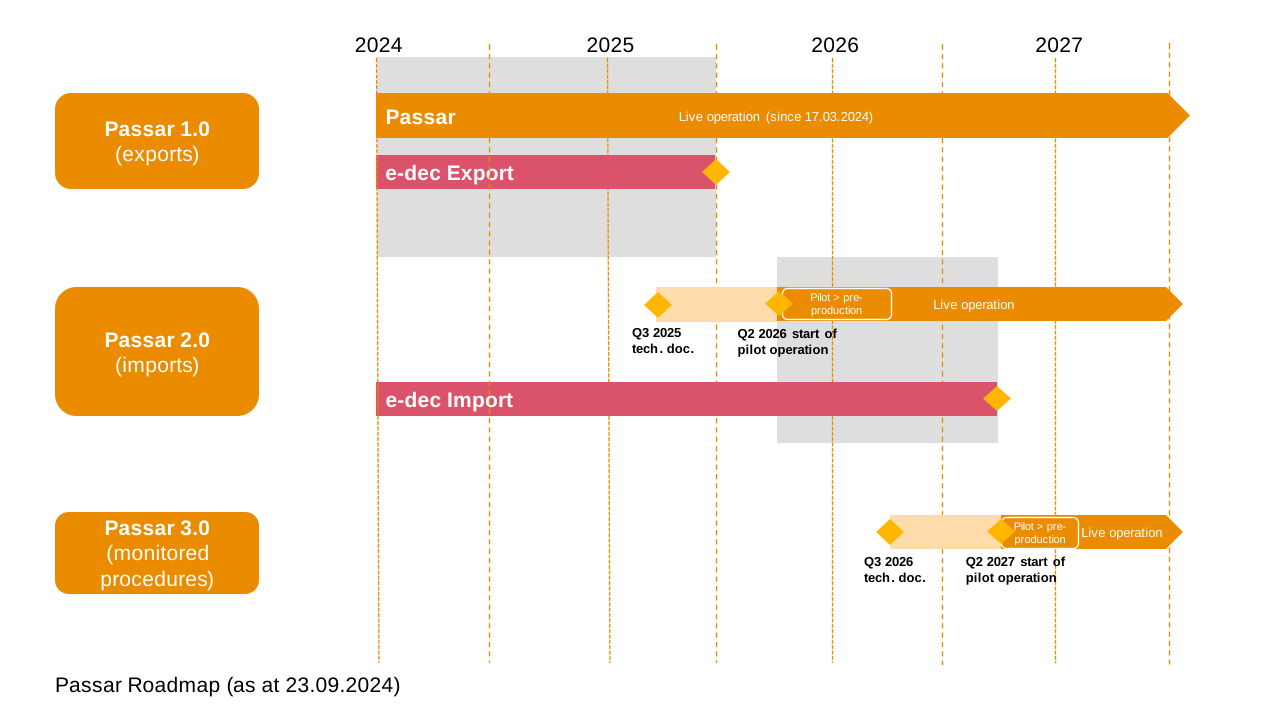
Passar Roadmap

Source: Website of the Federal Office for Customs and Border Security (FOCBS)

The SAP GTS shift

While Swiss customs moves to Passar, SAP Global Trade Services (SAP GTS) is also at a pivotal juncture. SAP GTS 11 reaches end-of-maintenance on 31 December 2025, meaning no further updates or patches will be provided. Companies committed to SAP GTS are therefore adopting SAP GTS Edition for SAP HANA (SAP GTS e4H), either on-premise or in the cloud. This new edition aligns with a modern customs platform like Passar, offering real-time analytics, robust compliance checks and a more intuitive user experience using FIORI tiles.

Regarding Passar, major changes to the declaration procedure are confirmed by existing and published documentation from Swiss customs authority. The changes will require new process flows, new message definitions and a changed interface between SEEBURGER BIS and Passar. The interface for the message exchange with Passar will be web services.

Passar 1.0 for export in Switzerland with SAP GTS – status September 2024

Source: SAP Regulatory Change Manager

In order to be able to exchange messages with the Passar backend system via the B2B hub of Passar, the following requirements must be met:

  • creation of a user account in ePortal
  • registration of a business partner with a valid UID (Identification number) as well as activation
  • assignment of business partner roles
  • establishment of a B2B network connection between SAP GTS and Passar via the B2B Hub
  • application of required tokens

It is already possible to begin onboarding to the new customs platform Passar now. More detailed information about the onboarding procedure can be found in SAP note 3337375 (CH Passar: Onboarding for the technical communication of the new customs platform Passar).

The new web service-based interface between SAP GTS and SEEBURGER BIS established for NCTS will also be used for Passar Export. The IDoc interface will no longer be used for export in Switzerland after e-dec export is closed. This requires changes to the IT infrastructure to enable web service calls in both directions between SAP GTS and SEEBURGER BIS. Note 3318211 (Customs Message Exchange: Introduction of the Web service for communication between SAP GTS and converter for customs communication) provides the enhancements needed for the interface on SAP GTS side. On the SEEBURGER side, BIS 6.7 is required.

At present, it is recommended to upgrade to Support Package 4 for SAP GTS, edition for SAP HANA 2023 to support the new interface for Passar between SAP GTS and the converter. For SAP GTS, edition for SAP HANA 2020, Support Package 6 or SAP GTS 11.0 Support Package 23 are strongly recommended. Please check the availability matrix for the latest support package at the time of implementation: SAP Product availability matrix

It is planned to deliver SAP GTS-related changes via notes if possible. Currently, SAP’s planned delivery date for Passar 1.0 export is 31 July 2025.

DSAG and PwC actively support the transition

PwC is a member of the Deutschsprachige SAP Anwendergruppe e.V. (DSAG) and the new subject matter group GTS – PASSAR Schweiz – Export- und Importprozesse. This group supports all member companies in the move from e-dec to Passar. Regular online and physical meetings enable members to ask questions, be briefed on technical information about system connections, message execution and process variants, and share information from different sources to keep everybody up to date.

For more information, please contact us at PwC or reach out directly to DSAG.

Why timely action matters

Whether you plan to stay on SAP GTS 11 this year or migrate to SAP GTS Edition for HANA, providing you have not already done so, you now have a year to prepare yourself for Passar 1.0 (exports). The big decisions will revolve around the timeline of the roadmap for the evolution of the GTS platform to a HANA/ FIORI environment and its synchronisation with the upgrade from e-dec Export to Passar 1.0 (exports). These are strategic decisions with technical, human and financial requirements, and understanding these will enable you to make more optimal choices.

Conclusion

The transition from e-dec to Passar, coupled with the shift from SAP GTS 11 to SAP GTS e4H, marks a significant milestone in Swiss customs and global trade processes. Companies that take a proactive approach will position themselves for smoother declarations, stronger compliance and a future-ready trade setup. Now is the time to assess your current systems, plan your migrations and seize the opportunities brought by modern customs technology.

You can read more about this topic in our earlier blog: From risk to resilience: the transition to SAP GTS E4H 2023 and Passar

EU Deforestation Regulation – Update : Anticipated 12-month delay and key updates on compliance


The European Commission has released new FAQ clarifications and a guidance document on the EU Deforestation Regulation (EUDR), offering detailed insights into various aspects such as traceability, geolocation and due diligence requirements. In response to global feedback, the Commission proposed a 12-month extension for implementation of the regulation. If accepted by the EU Parliament and Council, this will give larger operators time until December 2025 and SMEs until June 2026 to fully comply with the new regulation.

The European Commission’s latest updates include two crucial documents: updated FAQs and a guidance document. Additionally, a user guide on the Information System has been also published along with online training appointments. These resources aim to help businesses navigate the complexities of the new regulation on deforestation-free products by clarifying key aspects, such as traceability requirements, legal requirements and geolocation standards, and the obligations of SMEs. 

While the updated documents provide clarity on certain aspects of the EUDR, preparing for compliance remains a significant challenge for companies. On the other hand, the additional timeline allows businesses to refine their processes and better align with sustainability goals, particularly in light of the forthcoming Corporate Sustainability Due Diligence Directive (CSDDD) regulation.

What is the EUDR? 

The EUDR is an environmental regulation that prohibits the placement of certain commodities linked to deforestation on the EU market. The EUDR focuses on the below high-risk commodities and related products: 

  • palm oil
  • soy
  • coffee
  • cocoa
  • wood
  • cattle
  • rubber 

Based on the EUDR, the commodities and products in scope must fulfil three cumulative requirements to be compliant and allowed on the EU market: 

  • No or negligible risk of deforestation.
  • Produced in accordance with local legislation.
  • Accompanied by a Due Diligence Statement (DDS).

Traceability

The recent updates to the EUDR FAQ provide several clarifications on geolocation and traceability. For example, the requirements have been simplified for small land plots under four hectares, allowing operators to use a single latitude and longitude point and it is mentioned that one DDS can cover more than one commodity and it can be consolidated to cover more shipments. Additionally, guidance has been provided on how to declare the place of production for mixed goods and under what circumstances operators can declare geolocation “in excess.” Operators are reminded that full traceability and documentation are crucial for compliance.

DDS submission and correction

The updated FAQ also elaborates on when operators and traders must submit a due diligence statement (DDS) before placing relevant products on the EU market or exporting them. The DDS reference number must be included in the customs declaration for products entering or leaving the EU, and it should be obtained prior to lodging the customs declaration. For products produced within the EU, the DDS submission is required once the product is physically available and a supply agreement has been finalised, regardless of payment, shipment, or transfer of ownership. A DDS number can be amended or cancelled within 72 hours unless the product has already been placed on the market.

Transitional period

The EU Commission also clarifies some questions with respect to the transition period. During these periods, operators and traders are not obligated to meet the EUDR requirements for products placed on the market before these respective deadlines. The transition period extends until December 30, 2024, with the exception of SMEs, who will have an extended transition until June 30, 2025 (these deadlines will shift by a year if the EU Parliament and Council accept the 12-month extension). Evidence for products placed on the market before the regulation’s full applicability can be provided through customs declarations for imported goods, while EU-produced goods may require various forms of documentation, such as production records or delivery notes, to demonstrate compliance.

The determination of whether a relevant commodity or product has been produced in accordance with the legislation of the country of production relies on the specific laws governing the area where the commodity was grown, harvested, or raised. The EUDR adopts a flexible stance by acknowledging a range of laws relevant to the legality of production without specifying which laws, as they can vary by country and change over time. However, only those laws that directly affect the legal status of the production area are deemed relevant. This includes laws related to land use rights, environmental protection, forest management, third-party rights, and labor rights, among others. Operators are required to gather information about applicable legislation in the countries and specific areas from which they source commodities, ensuring that they comply with national and international laws. Specificities that need to be collected include for example official documents from authorities, contracts with local communities, and environmental assessments. Additionally, operators must be vigilant regarding the risk of corruption in the countries of production, taking extra measures to verify the authenticity of documents where corruption risks are high.

Directorate-General Taxation and Customs Union has also published new TARIC codes addressing the requirements of EUDR. For example, a new TARIC document code C716 has to be used to declare that a company is in possession of the required due diligence statement (DDS). Code Y129 has been established for products listed with an HS code in the regulation but not derived from the relevant commodity. This allows the declarant to indicate that, while the product falls under a nomenclature code impacted by the EUDR, it is not subject to the regulation because it is not produced from the specified commodity.

Although the updated documents provide additional guidance for companies, certain areas still need further clarification. The Commission is developing a benchmarking system to classify countries based on their deforestation risk, enhancing risk assessments for operators. It will also further clarify the role of certification schemes in risk mitigation and is developing specific criteria for sufficient documentation in complex supply chains. Moreover, guidance is being prepared on the definition of “agricultural use,” agroforestry practices, and other legal aspects of interest. The Commission continues to engage with stakeholders to provide informal guidance and good practice examples while addressing commodity-specific aspects.

The numerous requirements under the EUDR present significant challenges for companies. Strong governance frameworks and effective data management are crucial to navigate these obligations. I recommend conducting a thorough assessment of your current compliance status and identifying any potential gaps. We can assist in several key areas to ensure EUDR compliance:

  • Impact Assessment: Support with identifying if your company qualifies as an operator or trader handling affected commodities.
  • Due Diligence Processes: Assistance with setting up due diligence procedures, identifying risks, and ensuring compliance with EUDR requirements. 
  • Governance Model: Assistance in setting up a governance model and implementing a control framework for yearly reviews and audit preparation.
  • Supply Chain Redesign: Support in creating a sustainable supply chain and adapting distribution processes to meet regulatory requirements, which go beyond EUDR.

For details please contact

Dora Forgacs
+41 75 413 18 61
Email

WEBINAR: “Chatbots”, “Artificial Intelligence”, and “Conversational Systems”


The Bots Are Coming! Are you Ready?

“Chatbots”, “Artificial Intelligence”, and “Conversational Systems” are all the rage in this age of digital transformation. But, what does it mean for you? PwC are running a 90-minute webinar, covering: How are companies actually using this technology to drive their business forward? What is the role of artificial intelligence? How do you make bots work within your organization? How do you decide where bots go within the user experience? How do you manage bots when your technology changes?

Date: Wed, Feb 13, 2019 1:00 PM EST (7:00 PM CET). You can register at this LINK.


Image source: unsplash.com


Global ITX webcast: Single digital economy


I am delighted to invite you to the next in the series of PwC’s global indirect tax webcasts: ‘EU: creating the single digital economy 2020-21’ on Wednesday 30 January 2019 at 3pm GMT. A panel of specialists from across PwC’s indirect and direct tax practices will discuss the EU Commission’s proposed implementing regulations for 2020-21 and the consequent indirect tax, customs, direct tax and technology systems implications.Read More »

Commodity Trading ITX Event in Geneva


I am pleased, together with PwC UK and PwC Netherlands, to invite you to our next event on Indirect Taxes in the Commodity Trading Industry that will take place:

Wednesday, 16 January 2019 at PwC Avenue Giuseppe Motta 50, 1202 Genève.

During this event our Commodity Trading and Indirect Tax experts will give you an update on Technology offerings and the impact of digital for commodity trading (e.g. robotics), environmental taxes and fraud, Brexit as well as recent ITX developments, such as the pending infraction procedure for the UK and customs in respect of a non-EU entity acting as the exporter of record.

To register for this event and get the full event programme, please contact:

Andrea Croizeau, Phone: +41 58 792 98 34 or Email: andrea.croizeau@ch.pwc.com

Our experts look forward to exchanging with you.


Bildquelle: unsplash.com

Technology and age


Klara is a retired maths teacher and she is only 2 years short of her 80th birthday. She is used to thinking logically and she has mastered the technological changes with flying colours. She learned how to use the internet, opened a Facebook account and observed what was happening in the web.

When she had to have a knee operation, she learned how to shop online and ordered her purchases to be sent to her home. That opened up for her great freedom and enabled her to take things easier when she was recovering.Read More »

Do we still need printed newspapers?


For many years I have had a newspaper subscription. When the digital version of the newspaper was introduced, I very quickly switched to the electronic version. It is easier, more practical, always to hand and one can search the archives. It is also friendlier to the environment, because not a single tree has to be felled because of my reading mania.

But I read the electronic issue differently from the printed paper. In the electronic version my approach is very focused and I really only look at what interests me particularly. I don’t even click on other topics and advertising annoys me terribly. Every advertisement is clicked away immediately, usually before it is even clear what they are advertising. The advertisements, which force me to watch them for a few seconds before I can remove them, make me so mad (after all someone is trying to force his will on me) that the supplier has no chance at all with me.

The printed issue is different. I leaf through the whole newspaper, frequently become interested in a subject, which I had skipped in the electronic version and read both the death notices (in the electronic version never) and even some of the advertisements. And that is good, because only in this way do I discover some exciting events, which I then attend and am grateful that I had discovered them at all. In the last issue there was the Swiss championships in Poetry Slam and also a lecture about Japan.

What is the future of printed newspapers? I fear that in 20 years they won‘t exist any more. Then I’ll presumably have to change the way I read the newspaper. But there are worse things.

To close, the professional information: the electronic version of the newspaper, which in the past carried a higher VAT rate than the printed newspaper, is now treated equally. Following the partial revision of the Swiss VAT Law at 1.1.2018 both are charged with the reduced VAT rate. I’m very pleased about that. It doesn’t matter that you hadn’t even noticed. But you can still be pleased.

China – Compliance


Chinese tax authorities is using technology to improve the efficiency of VAT collection and management – Are you ready for this?

China managed VAT by invoice, therefore VAT invoice management is a key point, and the Chinese tax authorities have been using information technology on VAT collection and management. Read More »

Blockchain will change the VAT world like no other technology before – what do you need to know


Blockchains are transparent and decentralised way of recording lists of transactions. Their best-known use is for digital currencies such as Bitcoin. The value of Bitcoin increased remarkably since it was launched and ceiling has not been achieved yet. There are many different ways of using blockchains to create new currencies. Hundreds of such currencies have been created in the past and new coming regulary into the market. Read More »

Tax as a critical component in every Finance transformation


PwC Washington DC shoot. Stairwell inside The Capitol, adjacent to the Capitol Visitor Center.I would like to inform you about our next webcast regarding Tax as a critical component in every Finance transformation:

In today’s environment, tax and finance functions are facing increasing challenges which require a fundamental re-evaluation of operations, processes, technology and personnel.Read More »