The Federal Court published a decision regarding insurance coverages offered in addition by travel/education providers. These supplies constitute an autonomous insurance service that is VAT-exempt and not eligible for option to tax. They are not an ancillary services to the education or travel services and lead to a input tax correction
Under the following link you can find the decisions and a summary in German, French and English.
New case concerning the VAT treatment of tools will be dealt with on ECJ level. It belongs to a dispute between Mercedes‑Benz AG in Germany and the Romanian tax authorities concerning tools Mercedes‑Benz purchases and makes available free of charge to suppliers and sub‑suppliers to produce car parts. The key question is whether such free of charge use constitutes a supply of services for consideration under EU VAT law when the finished parts are sold through intermediaries rather than directly to Mercedes‑Benz.
Background of the case
Mercedes-Benz AG in Germany (hereinafter referred as Mercedes-Benz) buys tools and provides them free of charge to suppliers and sub-suppliers in Romania to produce parts, exclusively for Mercedes-Benz. Ownership of the tools remains with Mercedes-Benz. Following a VAT refund request submitted by Mercedes Benz, the tax authorities in Romania imposed additional VAT and argued that the free provision of the tools should be considered a taxable supply of services for cases where sub-suppliers were involved as there was no direct and immediate link between the free provision and its exclusive use for Mercedes Benz’s business.
Positions of the Parties
1. Mercedes‑Benz’s position:
1. The tools are used exclusively for Mercedes‑Benz’s business; the parts produced ultimately reach Mercedes‑Benz (directly or via intermediaries).
2. Free provision of tools in this context should not be deemed a taxable supply for consideration, because the use is for the owner’s business purposes.
3. A direct invoicing link between the producer and Mercedes‑Benz is not required; the presence of intermediaries does not change the exclusive benefit and business purpose.
2. Tax authorities’ position:
1. To avoid treating the free provision as a taxable supply for consideration, Mercedes‑Benz must prove the tools are used for its own business and not for other taxable persons.
2. The interposition of intermediaries (e.g., producer invoices a supplier, who then invoices Mercedes‑Benz) breaks the direct and immediate link between the free provision and its exclusive use for Mercedes‑Benz’s business.
3. In the absence of a direct invoicing relationship between the manufacturer and Mercedes‑Benz, the free provision becomes a supply for consideration under national rules.
We recommend monitoring this important case as it will affect VAT treatment for tooling and similar arrangements across supply chains where ownership and use are separated and intermediaries are involved. The CJEU may clarify whether a direct invoicing relationship is required to avoid deeming the free provision of tools for production purposes as a taxable supply for consideration when the end‑products are ultimately for the owner’s exclusive benefit.
In case of questions, please feel free to contact:
Are you ready to shape global tax strategy at a company that moves millions every day? Step into a high-impact role where your expertise drives innovation, compliance, and collaboration across borders.
We Elevate… Your Responsibilities
Leading the global tax accounting and reporting process, including quarterly and annual tax provisions, notes, budgeting, and forecasting
Ensuring compliance with international tax frameworks, including OECD Pillar 2, at both global and local levels
Advising on tax and tax accounting implications of business transactions, including M&A and intercompany arrangements
Proactively identifying, developing, and implementing strategic tax planning initiatives, while supporting external audits and managing tax authority relationships
Collaborating with finance, legal, and business units to identify and manage tax risks
Developing and implementing global tax policies, internal controls, and procedures, providing trainings, and mentoring junior team members
We Elevate… Your Best Self
Academic degree in Taxation, Accounting, Finance, or a related field; professional certifications such as CPA or (Swiss) Certified Tax Expert are a plus.
Excellent analytical, communication, and project management skills, with the ability to effectively handle complex topics.
Strong written, verbal, and presentation skills; able to explain complex customs or tax matters clearly to non-specialists.
Self-starter, highly motivated, and hands-on; proactively identifies critical topics, develops solutions, and implements them across functions and regions.
Culturally sensitive and able to work effectively in diverse, global teams.
Ability to manage multiple tasks in parallel while maintaining attention to detail.
Creative mindset and proactive personality, with the ability to work independently.
Proficient in MS Office, including Excel, and PowerPoint; experience with SAP and Tagetik is a plus.
Fluent in English, both written and spoken
We Elevate… You
We will offer you a position in a future-oriented industry with a diverse product range, as well as attractive and performance-related compensation
Development opportunities: You will start with a job-specific onboarding program and will be supported by us through technical and soft skills development programs
Work-life balance: We support you in managing your professional and personal life through flexible working hours
Health: Your health is important to us. You will benefit from a variety of health programs, including discount with fitness centres and in-house sporting events
Corporate benefits: You will have the opportunity to benefit from attractive employee discounts
Diversity: We promote and foster a culture of diversity
Can You Elevate Us?
Be part of a highly driven organization where high performance connects people and is a vital part of achieving strong business results. Please send us your complete application documents (CV, Reference Letters and University Diplomas).
At Schindler Group we value inclusion and diversity, and practice equity to create equal opportunities for all. We endeavor that all qualified applicants will receive consideration for employment without regard to age, race, ethnic background, color, religious affiliation, union affiliation, gender, gender identity, sexual orientation, marital status, national origin, nationality, genetics and health or disability.
Any unsolicited application from Recruitment Agencies is deemed to be rejected and does not constitute in any manner an offer from a Recruitment Agency.
Position Summary: Please provide one or two general sentences that describe the position.
This position is a critical role responsible for managing European tax matters for UGI’s U.S – headquartered multinational enterprise. The Senior Tax Manager will provide strategic tax support, ensure compliance with European direct and indirect tax requirements, along with M&A support. This position will partner with business and finance leaders across the region, while also maintaining relationship with tax support advisors.
Comparison to Similar Roles: If there are other positions similar to this position, please list them and identify areas in which this job might be considered bigger or smaller to the comparison jobs.
Senior Tax Manager, International
Essential Functions: Essential Functions document the specific and important requirements to achieve results. Essential job functions must articulate the key responsibilities the employee is required to perform in the role- List no more than five (5) essential functions, (keep in mind percentage of time spent to only document those key items that take up the majority of the jobholders time and avoid responsibilities that only happen occasionally throughout the year). Items should be limited to two (2) sentences and should be concisely described.
1.
Lead and manage European tax planning, strategy, compliance, reporting processes in coordination with corporate headquarters and regional finance teams
2.
Oversee preparation and review of European income tax returns, VAT, and other indirect tax filings, ensuring accuracy and timely submission.
3.
Monitor and interpret changes in European tax legislation, OECD guidelines, and EU directives, assessing their impact on the company.
4.
Support transfer pricing compliance, documentation, and implementation of intercompany policies across Europe.
5.
Provide tax support for European business operations, supply chain, financing, and cross-border transactions.
6.
Manage relationships with external advisors and tax authorities across multiple jurisdictions.
7.
Partner with Treasury, Legal, and Finance teams to optimize cash tax positions, mitigate risks, and support strategic initiatives.
8.
Assist with quarterly and annual tax provisions under U.S. GAAP/IFRS, including ASC 740 reporting for European entities.
9.
Support tax controversy and audits across European jurisdictions, ensuring effective resolution
10.
Mentor and develop team members and contribute to building a high-performing tax function
The above list is not exhaustive of all essential functions of the job. This is not designed to contain or be interpreted as a comprehensive inventory of tasks assigned to this role. All essential functions must be performed in accordance with applicable laws, regulations and company policies including the Company’s Code of Ethics and Standards of Business Conduct.
Knowledge, Skills and Abilities: Please list key skills/bodies of knowledge or task knowledge to help the incumbent understand/access the tools required to deliver on Essential Functions.
Experience with tax compliance and reporting requirements and deadlines, specifically ASC740
Experience with income tax accounting, generally accepted accounting principles, and SOX to perform key controls over financial reporting.
Prior experience in a corporate tax group or tax accounting firm and the ability to recognize potential issues and to communicate accordingly.
Strong technical expertise in European corporate income tax, VAT/indirect taxes, and transfer pricings.
Excellent analytical, communication, and leadership skills.
Ability to work across disciplines such as payroll, accounts payable, plant accounting and G/L accounting in the finance department as well as other applicable departments to gather information.
Requires excellent time management and organizational skills as well as excellent written and verbal communication skills.
Fluent in English; proficiency in other languages is an advantage.
Strong interest in tax technology related topics including developments in AI and data analytics.
Proven Track record in successful implementation of projects to achieve strategic goals.
Minimum Qualifications: Please list required levels of education, professional certifications and specific experience.
Education:
Master’s degree in Tax, Accounting, Finance, or Law; advanced tax qualification (e.g., CPA, CTA, or equivalent) preferred.
Length of Experience:
Minimum 7 – 10 years of progressive corporate tax experience, ideally with a mix of Big 4/public accounting and multinational corporate in-house roles.
Certifications:
Licenses/Registrations:
Other:
Solid understanding of U.S. international tax concepts (e.g., GILT, BEAT, FDII, Foreign Tax Credits, Pillar II) a strong plus.
Organizational Context: This provides context in defining this role’s impact within the organization and captures relevant, quantifiable information about the scope of the role. These metrics are a reflection of the role’s impact, influence or magnitude and not intended to be used as performance indicators. Metrics may be reported in ranges. Headcount Managed may include consultants/contractors where appropriate.
Direct Reports (#):
0
Budget Responsibility:
$ 0
Total Headcount Managed (#):
0
Physical Requirements and Working Conditions: The coding below will help you determine the frequency for each task.
Work Environment (Please check the boxes that apply.)
X
Office Environment
Outdoors
Plant
Vehicle
Overall Strength Demands: The overall physical requirements of the job. (Pleasecheck only ONE box.)
X
Sedentary – Exerting up to 10 lbs. occasionally or negligible amounts frequently; Sitting most of the time.
Heavy – Exerting 50 -100 lbs. occasionally, 10-25 lbs. frequently or up to 20 lbs. constantly.
Light – Excreting up to 20 lbs. occasionally, or up to 10 lbs. frequently, or negligible amounts constantly OR requires significant walking or standing.
Very Heavy – Exerting over 100 lbs. occasionally, 50-100 lbs. frequently, or up to 50 lbs. constantly.
Medium – Exerting 20-50 lbs. occasionally, 10-25 lbs. frequently, or up to 10 lbs. constantly.
Additional Physical Demands
NA- Not Applicable
Rare (R)- 0%-30% of the time
Intermittent (I)- 30%-60% of the time
Often (O)- 60%-90% of the time
Critical (C)- 90%-100% of the time
C
Visual acuity (e.g., need to prepare and analyze data, to transcribe documents, to view a computer, to read, to inspect objects or operate machinery)
C
Finger dexterity (e.g. picking, pinching, typing or other working that uses the fingers)
Sie tragen die Verantwortung für den Betrieb und die Weiterentwicklung der Group Tax Funktion. Dies umfasst insbesondere folgende Aufgaben:
Direkte/indirekte Steuern
Konzernsteuerplanung (Optimierung des Konzernsteuersatzes)
Planung und Umsetzung der Gewinnrepatriierungs-Konzepte (Lizenzen, Management Fees, Dividenden etc.) in Zusammenarbeit mit Group Treasury.
Management von Steuerplanungen, Steuerprüfungen sowie steuerlichen Gerichtsverfahren bei den Gruppengesellschaften (in Zusammenarbeit mit lokalen Steuerberatern)
Koordination mit lokalen Steuerverantwortlichen bei den Tochtergesellschaften und mit Steuerberatern
Optimierung von steuerlichen Strukturen (rechtliche Einheiten, Betriebsstätten etc.)
Optimierung der indirekten Steuern / Quellensteuern / Mehrwertsteuern
Transfer Pricing
Pflege der Transfer Pricing Guidelines zusammen mit den Geschäftsführern
Erstellung von Transferpreis-Dokumentationen, Benchmark-Studien, CBCR etc.
Umsetzung von Pillar2
Reporting
Swiss GAAP FER Steuer-Reporting
Berechnung Festsetzung der Steuerrückstellungen auf Stufe Konzern
Erstellung der Steuererklärungen für die CH-Betriebe mit interkantonaler und interkommunaler Steuerausscheidung in Zusammenarbeit mit den Steuerberatern
Einführung eines Tax-Compliance-Management-Systems in Deutschland
Mehrwertsteuer
Business Partner für Mehrwertsteuer-Themen
Schulung von Mitarbeitern
Weitere Aufgaben
Weiterentwicklung und Implementierung der Tax Strategy
Schulung von Mitarbeitern konzernweit in steuerlichen Themen
Steuerliche Beurteilung von M&A-Projekten
Steuerliche Beurteilung von Konzernprojekten (z.B. Investitionen)
Mitarbeit bei fachübergreifenden Projekten
Was Sie mitbringen
Sie bringen einen Fachhochschul- oder Universitätsabschluss im Bereich Wirtschaft oder einem verwandten Studienfeld mit. In Ergänzung zum Studium zeichnen Sie sich durch folgende Ausbildungen und Erfahrungen aus:
Sie haben mehrjährige Erfahrung im Bereich Tax in einem international tätigen Schweizer Industriekonzern.
Idealerweise haben Sie eine Weiterbildung zum Steuerexperten
Sie sind offen und können gut auf Leute zugehen.
Sie sprechen fliessend Deutsch und Englisch.
Persönlichkeit
pragmatisch
teamorientiert
hands on
Berichtslinie
Direkt an den CFO.
Interessierte Kandidatinnen und Kandidaten können sich gerne direkt an Frau Rea Sidiropoulou wenden: R.Sidiropoulou@glastroesch.ch | +41 62 958 51 75
On 31 July 2025, President Trump signed executive orders imposing new ‘reciprocal tariffs’ on a wide list of countries. The changes are to take effect seven days after the date the order is signed (7 August 2025). The order also notes that countries negotiating trade and security agreements with the US will remain subject to these new tariffs until deals are finalised.
Tariff rates will range from 10% to 41%; notably, for Swiss-originating goods, this rate is established at 39%. It is also important to mention that pharmaceuticals are currently exempt due to an ongoing US investigation into whether imported pharmaceuticals pose a national security risk.
Earlier in July, the United States and the European Union announced a new trade agreement. Under this deal, most EU goods will face a 15% tariff. Although the official legal act confirming these arrangements is still pending, it is important to consider the potential implications for the pharmaceutical industry.
A key aspect of the agreement, as highlighted by the EU, is the assurance that any future US tariffs on EU pharmaceutical exports will be capped at 15% (if and when tariffs on pharmaceuticals are introduced in the US). This understanding was reached during discussions between European Commission President Ursula von der Leyen and US President Donald Trump. The agreement marks a major step in addressing concerns within the EU pharmaceutical industry, which previously faced the risk of tariffs as high as 200%.
Moreover, President Trump has also demanded that major pharmaceutical companies commit to providing US drug prices at ‘most favoured nation’ (MFN) levels, matching the lowest prices offered in other developed countries, and warned of government action if they do not comply.
Potential impact on pharmaceutical prices
When new tariffs are imposed on imported pharmaceuticals, a common concern is whether pharmaceutical companies will respond by raising their prices. At first glance, it seems logical that companies would pass on the increased costs from tariffs to consumers by charging more for their products.
The US pharmaceutical market operates differently from other markets. Prices are often negotiated, not simply set on a federal level. Now, the government’s stepping in with new measures to lower drug costs. A recent executive order introduces a most-favoured-nations (MFN) pricing model. This requires manufacturers to match the lowest prices they offer in other developed countries for government-funded programmes. It’s most likely to impact Medicaid, but also parts of Medicare, the Veterans Health Administration, and the Indian Health Service. However, the government’s not stopping there. They’ve sent letters to big pharma companies, asking them to apply MFN prices to all Medicaid patients, reconsider pricing for other developed nations and open avenues for direct sales in the US.
Government programme patients may see lower drug prices due to the MFN order. That’s good news for many, especially the low-income population. However, currently, about 25 million Americans are uninsured. They’re already facing full list prices for medications. Now, with the One Big Beautiful Bill Act (OBBBA) on the horizon, we could see even more people losing coverage due to a change in the eligibility criteria. Uninsured patients aren’t likely to benefit from the MFN order. In fact, they might end up bearing the brunt of any industry pushback. Drug manufacturers, facing price cuts in government programmes and increased tariffs, might try to recoup losses by raising list prices. As a consequence, we might be looking at a price increase for uninsured patients.
For example, a small tariff might be absorbed by the company or spread across many products, resulting in little to no change in prices. In contrast, a large tariff could make it difficult for companies to avoid raising prices without affecting their profits or market share. In a competitive pharmaceutical market, companies may be cautious about implementing price increases for fear of losing market share to equally effective but less expensive alternatives. Therefore, companies might choose to absorb some of the tariff costs rather than risk losing market share and revenue. Ultimately, whether and how much pharmaceutical prices rise in response to tariffs might depend on a complex mix of these economic and market considerations.
Short-term solutions
Pharmaceutical companies facing potential US tariffs can take several practical steps to minimise the impact in the short term. These actions include adjusting product pricing, reviewing and potentially changing the origin of products, rerouting supply chains, and renegotiating supplier contracts or delivery terms. Such measures are relatively straightforward to implement and can help companies respond quickly to changing trade conditions.
Pharmaceutical companies can also consider implementing the “first sale for export” rule as part of their short-term strategies. This approach allows companies to base the customs value of imported goods on the price paid in the first sale of a multi-tiered transaction, rather than the final sale price to the US importer. By leveraging this rule, companies may be able to reduce the dutiable value of their products, thereby lowering the overall tariff burden. The first sale for export rule requires careful documentation and coordination with suppliers to ensure compliance, but it is a practical and effective tool that can be quickly adopted. Like other no-regret actions, utilising the first sale for export rule can provide immediate benefits and enhance a company’s ability to manage costs in a volatile trade environment.
Additionally, companies can explore more specialised customs strategies, such as using free trade zones or bonded warehouses. These approaches not only help manage immediate risks but also build greater operational flexibility.
Importantly, these are “no-regret” actions, meaning they are beneficial regardless of how the trade environment evolves. Adopting these strategies allows pharmaceutical companies to strengthen their resilience and maintain competitiveness, even amid ongoing uncertainty. Given the highly regulated nature of the pharmaceutical industry, it’s necessary to pressure-test any changes to the supply chain from a regulatory perspective. Companies must ensure that potential solutions comply with healthcare laws and health authority guidelines.
Relocating production to the US: Feasibility and challenges
Another important consideration is the US government’s suggestion that pharmaceutical companies should move their production to the United States within a 12- to 18-month timeframe. Researchers indicate that imposing tariffs to encourage domestic manufacturing is unlikely to be effective in the pharmaceutical sector. The high costs, lengthy timelines, as well as regulatory burdens to establish new manufacturing facilities in the US, often taking 8 to 10 years to become financially viable, far exceed any potential short-term benefits from tariffs. This timeline is also much longer than the typical political cycle, making such a move less attractive. In the long term, some experts predict that companies may shift production from countries with high tariffs to those with lower tariffs, as has occurred in other industries. However, this strategy could increase the risk of supply chain disruptions and potential drug shortages.
While the new EU–US trade deal introduces a degree of clarity and stability for the EU pharmaceutical industry, it does not eliminate all areas of concern. One of the unresolved issues is the status of tariffs on pharmaceuticals, which could have a substantial impact on pricing, supply chains, and market access. As the regulatory and economic environment continues to evolve, pharmaceutical companies will need to conduct thorough risk assessments and strategic planning to ensure they can adapt effectively and maintain their competitive edge.
How can PwC support you?
At PwC Switzerland, our team of customs and regulatory affairs specialists brings together extensive legal, technical, and operational knowledge to guide your business through the ever-changing landscape of global trade. We understand that customs and regulatory affairs management can be complex and challenging, especially as regulations evolve. That’s why we offer end-to-end support across all aspects of customs and regulatory affairs compliance and strategy:
Supply chain and operations: Our supply chain and operations consulting experts can help you map your physical and financial flows to quickly understand current tariff exposure and potential mitigation options in the face of the anticipated changes due to US trade tariffs. We typically work in close alignment with our customs experts to assess preferred customs options and link tax concepts with regulatory, risk and general portfolio considerations. We can support you on fit-for-purpose manufacturing network planning that can encompass all aspects of safeguarding the crucial US market, from API and raw materials sourcing to a localisation strategy that can satisfy the requirements of US health authorities and policymakers.
Expert guidance on regulatory changes: Our customs and pharma legal regulatory affairs experts closely monitor developments. We help your company understand the implications of new legislation, ensuring you are fully informed about how these changes may affect your operations.
Tailored compliance solutions: We work with you to assess your current customs and regulatory affairs processes and identify any gaps or risks. Our team assists in implementing the necessary measures to ensure your business remains compliant with all relevant regulations.
Unlocking opportunities: Beyond compliance, we help you identify and capitalise on opportunities that new customs regulations may offer. This could include optimising your supply chain, reducing costs, or streamlining your customs procedures.
Let’s talk
For a deeper discussion on this topic, please contact:
Geopolitical shifts and rising trade tensions are reshaping global supply chains — with major implications for businesses operating in or with China, India and other key markets.
In this live webinar, PwC experts from Switzerland, China and India will explore the latest developments in tariffs and trade policy, including US-China measures, regional responses and the broader economic outlook. The discussion will highlight how these shifts are affecting in- and outbound trade and what businesses can do to stay ahead.
What to expect:
The impact of recent tariff announcements and retaliation measures
Economic and policy developments in China and India
Indian market perspectives on trade with China and beyond
Practical actions to manage customs, mitigate tax risks and protect operations
Don’t miss this opportunity to hear directly from our specialists and prepare your business to respond with confidence.
Your hosts
Agenda
10:00 am
Welcome and introduction
Moderated panel discussion
Q&A session You can send us your questions in writing via the Q&A function on Microsoft Teams during the webinar.
11:00 am
End
Date and location
Wednesday, 20 August 2025 10:00–11:00am CEST
Online On Microsoft Teams. Please register to receive the access link.
Draussen ist es unglaublich heiss, und die einzige wirkliche Abkühlung scheint der See zu versprechen. Ich habe meinen Badeanzug mit langen Ärmeln, eine Mütze und eine Sonnenbrille angezogen, mich dick mit Sonnencreme mit Schutzfaktor 50 eingecremt und bin zur Seebadi gegangen. Natürlich war sie voll. Mehr als das. Man konnte kaum einen Platz finden, um ein Badetuch auszubreiten, ohne gleich ein anderes zu berühren – ganz normaler Badi-Stress.
Ich legte meine Sachen ab und ging direkt ins Wasser. Überraschend war, dass es gar nicht erfrischend war. Das Seewasser war so unglaublich warm, dass ich beim Hineingehen nicht einmal ein bisschen gefröstelt habe.
Das Schwimmen war einfach toll. Ich liebe es, weit zu schwimmen und endlich von allen Unterbrechungen frei zu sein. Kopfhörer habe ich im Wasser nie dabei – deshalb ist es einer der seltenen Momente, in denen meine Gedanken frei fliessen und meine Fantasie Luftschlösser in unterschiedlichsten Dimensionen bauen kann. Ich bin in Richtung Oberwil geschwommen. Weil ich Zeit hatte, konnte ich eine gefühlte Ewigkeit schwimmen. Ich beobachtete die Ufer, das Geschehen am Wasser – aber eigentlich war es wie eine Meditation, und ich war weit weg, irgendwo im Nirwana.
Ich wusste, dass ich leider nicht den ganzen Abend schwimmen kann, sondern irgendwann zurückmuss – zu meinem Computer, um noch ein paar E-Mails zu beantworten, wie ich es heute versprochen hatte. Ich bin seit jeher sehr pflichtbewusst.
Es ging mir auch weniger um den sportlichen Aspekt. Ich bin ganz entspannt Brust geschwommen, mit dem Kopf stets über Wasser, mit Sonnenbrille und Mütze – einfach herrlich. Aber irgendwann, nach meinem Zeitgefühl, musste ich umdrehen. Eine Uhr hatte ich keine dabei – ich besitze gar keine und will auch keine haben. Es gibt genug Stress, auch ohne Uhr.
Ich drehte also um und schwamm zurück. Nach ein paar Metern sah ich ein Insekt im Wasser – wahrscheinlich eine Biene – das ums Überleben kämpfte. Ich hätte ihr gerne geholfen, wusste aber nicht wie. Ich war sehr weit vom Ufer entfernt. Ich schwamm weiter, aber die Biene ging mir nicht aus dem Kopf. Nach einigen weiteren Metern drehte ich wieder um, um sie zu suchen.
Es war gar nicht so einfach, sie wiederzufinden, aber schlussendlich gelang es mir. Ich überlegte, was ich tun konnte. Der einzige Ort, wo ich sie deponieren konnte, war meine Mütze. Ich zog sie aus und versuchte, mit der Aussenseite der Mütze die Biene aus dem Wasser zu fischen. Technisch war das ein ziemlich anspruchsvolles Unterfangen, aber nach ein paar Versuchen klappte es. Ich setzte die Mütze mit der Biene wieder auf und hoffte, dass sie genug Kraft haben würde, sich mindestens eine halbe Stunde lang zu halten, bis ich das Ufer erreichte.
Dann schwamm ich weiter – und vergass die Biene.
Am Ufer angekommen, erinnerte ich mich wieder an sie. Ich zog die Mütze aus – und ja, die Biene war immer noch da. Die halbe Stunde an der Sonne hatte ausgereicht, damit sie trocknen konnte. Sie hatte wieder an Volumen gewonnen und war ein ziemlich stattliches Exemplar. Ich schüttelte sie vorsichtig auf einen Busch, denn auf dem Gras war in der Badi kein Platz, und das Risiko, dass sie jemand zertritt, war zu gross.
Ich kann nicht versprechen, dass diese Geschichte ein Happy End hat – aber ich hoffe es sehr. Hoffentlich hat die Biene ihren Weg nach Hause gefunden.
Outside, it was unbelievably hot, and the only real promise of cooling down seemed to be the lake. I put on a swimsuit with long sleeves, a cap, and sunglasses, slathered myself thickly with sunscreen (SPF 50), and went to the lake beach. Of course, it was packed. More than that — it was almost impossible to find space to lay a towel on the ground without touching another towel. Typical lake beach stress.
I put down my stuff and quickly slipped into the water. Surprisingly, the water wasn’t refreshing at all. The lake water was so incredibly warm that I didn’t feel even a little chill when entering.
Swimming was just wonderful. I love swimming far out and finally being free from all interruptions. I never wear headphones in the water, so this is one of the rare moments when my thoughts can flow freely, and my imagination can build castles in the air of various dimensions. I swam toward Oberwil because I had time — I could swim for ages. I observed the shore, the happenings on the water, but really it was like a meditation, and I was far away somewhere in nirvana.
I knew, unfortunately, that I couldn’t swim for the rest of the evening but would eventually have to return to my computer to answer some emails as I had promised today. I’ve always been responsible like that.
It wasn’t really about sport — I swam breaststroke quite relaxed, with my head always above water, sunglasses, and cap, just comfortably. Simply wonderful. But now, according to my feeling of time, I had to turn around. I didn’t have a watch. For one thing, I don’t own a watch and don’t want one. There’s already enough stress without a watch.
I turned around and swam back. After a few meters, I saw an insect in the water fighting for its life — probably a bee. I wanted to help but didn’t know how. I was very far from the shore. I kept swimming, but the bee stayed in my mind. After a few more meters, I turned around and went back to find the struggling bee.
It wasn’t easy to find her, but eventually, I did. I thought about what to do. The only place I could put her was my cap. I took off my cap and, splashing water, tried to fish the bee out of the water through the outer edge of the cap. Technically, it was a challenging task, but after a few tries, I succeeded. I put the cap with the bee back on my head and hoped she had enough strength to lift herself up for at least half an hour until I reached the shore. Then I continued swimming and forgot about the bee.
When I got to shore, the bee came back to my mind. I took off my cap. Yes, the bee was still there. But the half hour in the sun had been enough for her to dry off. She had gained volume and was a pretty substantial specimen. I carefully shook her onto a bush because there was no space on the grass at the lake beach and too much risk she would be stepped on.
I can’t promise this story has a happy ending, but I really hope so. Hopefully, the bee found her way home.
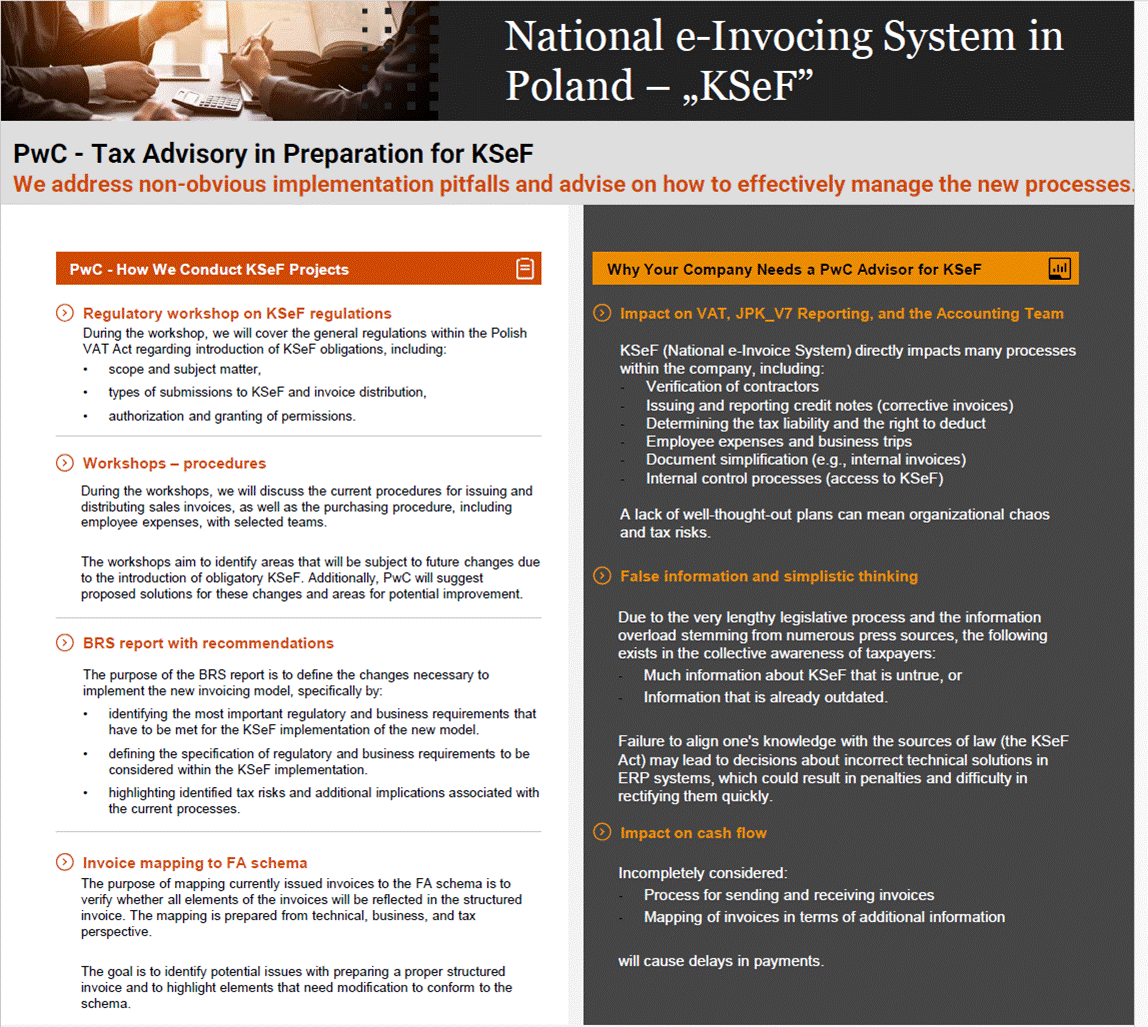
Introduction of Polish E-invoicing System (“KSeF”), which is coming into effect in Poland on February 1st or April 1st, 2026 will significantly impact
Polish companies,
Foreign companies registered for VAT in Poland,
Foreign companies with a fixed establishment in Poland.
What is KSeF?
KSeF is a centrally managed IT system through which taxpayers will be obliged to issue and send their invoices to their contractors. It is a game changer, completely altering the current practice, impacting the existing billing and process flows.
KSeF and Swiss entities
Foreign companies registered for VAT in Poland will be required to use KSeF if they have a fixed establishment in Poland. In other cases, they may use KSeF voluntarily.
Nevertheless, the situation is currently being assessed as to whether foreign entities with only VAT registration in Poland, although not required to issue invoices in KSeF, will have to receive invoices via KSeF.
Fixed Establishment
Currently, I strongly recommend that all entities with a registered office outside of Poland, but with VAT registration in Poland, (a) analyze whether they have a fixed establishment, and (b) confirm its absence through an individual interpretation request.
We are already seeing that tax authorities are conducting inquiries in this matter, and it should be expected that, closer to the implementation of KSeF, there will be an expectation to provide explanations regarding the existence of a fixed establishment in Poland or outside of Poland.
Please see suggestion how the project can be tackled











 Michaela Merz