EU Parliament decided to delay EUDR implementation for 12 months, i.e. until 30 December 2025. The 24 months delay was rejected.
The Parliament also adopted other amendments proposed by the political groups, including the creation of a new category of countries posing “no risk” on deforestation in addition to the existing three categories of “low”, “standard” and “high” risk.
Ich wohne eine halbe Stunde von Zürich entfernt. Es ist ein toller Ort mit sehr liebenswürdigen Menschen und einem fantastischen See. Ich habe eine unglaubliche Panorama-Aussicht über die Berge und den See. Ein Blick aus dem Fenster ersetzt das Fernsehen. Außer zwischen November und Februar. Dann plagt uns der Nebel. Aber was für ein Nebel! An manchen Tagen ist der Nebel so weiß und dicht, dass er mich an Kinderbrei erinnert. Kinderbrei zu essen ist eine meiner schönsten kindlichen kulinarischen Erinnerungen. Doch von Kinderbrei umgeben zu sein, ist einfach nur ekelhaft. Der Nebel ist sehr hartnäckig. Ohne Probleme hält er sich den ganzen Tag bis in die Nacht. Man sieht nichts. Gar nichts. Nur Grau, Weiß oder Schwarz. Den Unterschied zwischen Tag und Nacht erkennt man an der Helligkeit. Nach ein paar Stunden in diesem dicken Nebel wird mir physisch übel. Nicht nur ein bisschen, sondern richtig übel. Zwei Dinge helfen dann: Bewegung und Sonne.
Jetzt hält sich der Nebel schon seit ein paar Wochen. Er ist nicht so undurchsichtig, wie er es im Februar sein kann, aber er ist Tag für Tag ohne Pause da. Ich halte es nicht mehr aus. In der Schweiz kann man dem Nebel mit einer 1,5-stündigen Fahrt entkommen. Also bin ich nach Interlaken gefahren. Ich musste in die Höhe, weil die Nebelgrenze bei 1100 m liegt und darüber herrliche, wolkenfreie Sonnentage zu finden sind. Am Morgen war es noch dunkel, und das Erwachen des Tages erkannte man nur am Wechsel von Schwarz-Milchig zu Grau-Milchig. Ich fuhr los, und nach etwa einer Stunde Fahrt kam der erste Sonnenstrahl, wie ein Guten-Morgen-Kuss. Man sieht den dichten Nebel, der unten wie ein Kissen zurückbleibt, und erfreut sich an den immer noch grünen Hängen der Berge (der Schnee kommt bald) und an der Sonne.
Eine Wanderung zum Gemmenalphorn auf 2061 m Höhe liegt vor mir. Offenbar hatten viele andere die gleiche Idee – von einem einsamen Aufstieg kann keine Rede sein. Es erinnert eher an eine Völkerwanderung. Es fühlt sich aber gut an, weil alle grüßen, wie wenn man die Nachbarin trifft. Alle, die heute unterwegs sind, scheinen glücklich zu sein und lachen sich gegenseitig an. Was für ein genialer Tag! Meine Atmung meckert ein bisschen, insbesondere auf dem letzten Teil der Strecke, weil es wirklich steil ist. Ich habe jedoch keine Lust, langsamer zu werden. Vielleicht gibt es morgen Muskelkater; wir werden sehen. Mit jedem Schritt und jedem Tropfen Schweiß geht es mir besser. Es ist angenehm warm, die meisten laufen im T-Shirt, ein Pullover reicht, und die Jacke kann man getrost im Rucksack lassen.
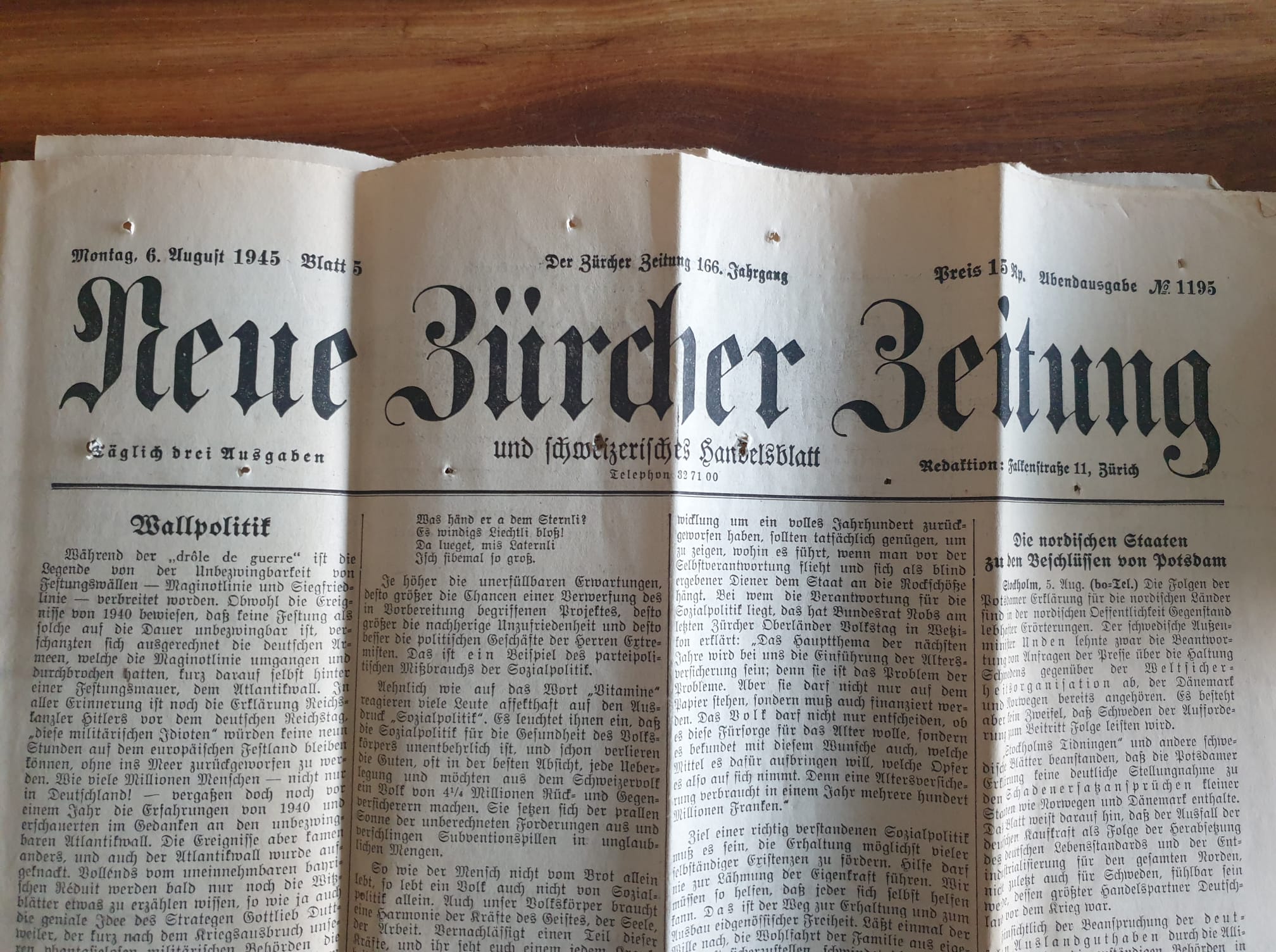
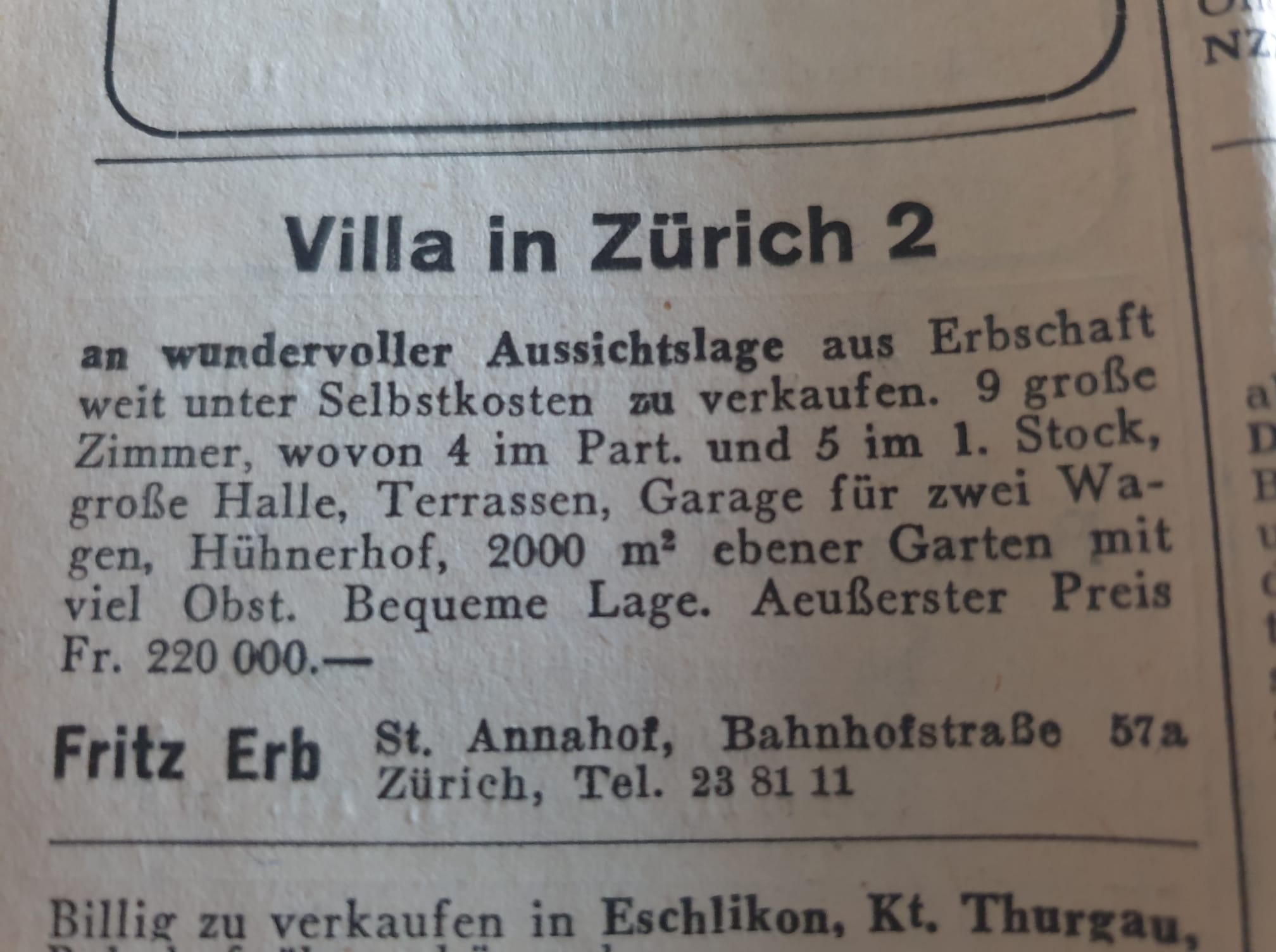
Am Anfang der Wanderung stoße ich auf ein altes Haus. Alle Fenster und Türen sind offen, und aus dem Inneren klingt es nach Abbrucharbeiten. Vor dem Haus steht eine Mulde mit altem Holz und sonstigen Resten. Ich bin neugierig und schaue hinein. Gerade wird die dünne Holzwand zwischen Küche und Wohnzimmer abgerissen. Für die Isolation wurden damals Zeitungen verwendet. Ich hebe eine Zeitung vom Boden auf und sehe, dass sie aus dem August 1945 stammt. Die Zeitung ist perfekt erhalten, und ich blättere sie durch. Sie ist viel dünner als heutige Zeitungen, und der wesentliche Teil besteht aus Anzeigen. Ich lese eine Immobilienanzeige, in der eine Villa mit 9 Zimmern, 2000 m² Garten und wunderbarer Aussicht in Zürich für 220’000 Franken angeboten wird. Schade, dass meine Großeltern nicht das Geld hatten, so etwas zu kaufen. Heute müsste das wohl einen Wert im zweistelligen Millionenbereich haben.
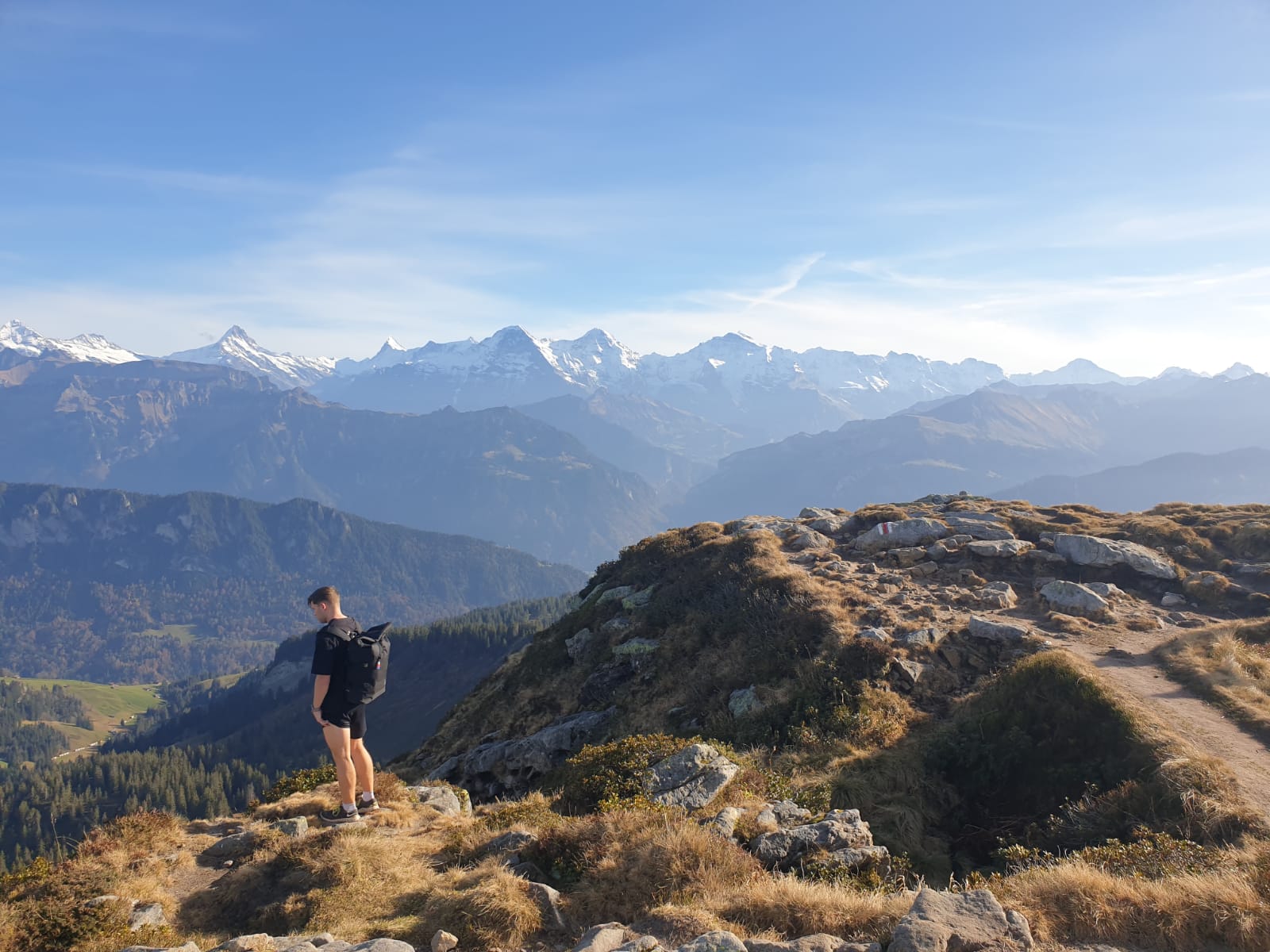
Der Aufstieg belohnt mich mit einem unschlagbaren 360-Grad-Ausblick. Ich könnte stundenlang in der Sonne auf trockenem Gras sitzen und die weite Gegend, die umliegenden Berge mit bereits verschneiten Spitzen und den See bewundern. Da es nach Sonnenuntergang aber kalt und eher ungemütlich wird, mache ich eine halbe Stunde Pause und trete dann den Abstieg ins Tal an, während ich die vielen Gleitschirmflieger beobachte, die auf den Hängen starten und ins Tal gleiten.
Zusammenfassung Ich kann gerne bestätigen, dass gegen den Nebel-Blues am besten Sonne kombiniert mit Bewegung hilft. Empfehlenswert sind gute Schuhe und eine Flasche Wasser. Die Wasserflasche habe ich leider am Samstag vergessen mitzunehmen. Umso schöner war das Trinken nach dem Abstieg!
I live half an hour from Zurich. It’s a fantastic place with very friendly people and an amazing lake. I have an incredible panoramic view over the mountains and the lake. One look out the window is better than watching TV. Except from November to February. Then, we’re plagued by fog. But what fog! On some days, it’s so white and thick that it reminds me of baby food. Eating baby food is one of my fondest childhood memories, but being surrounded by it is just gross. The fog is very persistent, easily sticking around from morning until night. You can’t see anything. Absolutely nothing. Just gray, white, or black. The difference between day and night can only be detected by the brightness. After a few hours in this thick fog, I start feeling physically ill. Not just a little bit – truly unwell. Two things help: exercise and sunshine.
The fog has now lingered for several weeks. It’s not as impenetrable as it can be in February, but it’s there every single day, without a break. I can’t stand it anymore. In Switzerland, there’s a remedy: drive for an hour and a half, and you can escape. So, I headed to Interlaken. I needed to get up into the mountains because the fog line is at 1100 meters, and above that, beautiful, cloud-free sunny days await. It was still dark in the morning, and you could tell dawn was coming only by the shift from blackish-milky to grayish-milky. I set off, and about an hour into the drive, the first sunbeam greeted me like a good morning kiss. You can see the thick fog lying below, like a cushion left behind, while enjoying the still-green slopes of the mountains (snow is coming soon) and the sunshine.
Ahead of me was a hike up to the Gemmenalphorn, at an altitude of 2061 meters. Clearly, many others had the same idea – it was far from a lonely ascent. It felt more like a migration. It was a good feeling, though, because everyone was greeting each other, as if meeting neighbors. Everyone out today seemed cheerful and was smiling at one another. What a brilliant day! My breathing started complaining a bit, especially on the last part of the trail, as it was truly steep. I had no desire to slow down, though. I might have sore muscles tomorrow; we’ll see. With each step and every drop of sweat, I felt better. It was pleasantly warm, with most people just in T-shirts, a sweater was enough, and you could easily leave your jacket in your backpack.
At the start of the hike, I came across an old house. All the windows and doors were open, and I could hear the sounds of demolition work inside. In front of the house was a dumpster filled with old wood and other debris. Curious, I took a look inside. They were just tearing down the thin wooden wall between the kitchen and living room. Back then, newspapers were used as insulation. I picked one up off the floor and saw it was from August 1945. It was perfectly preserved, so I flipped through it. It was much thinner than today’s papers, with most of it dedicated to advertisements. I read a real estate ad offering a villa with 9 rooms, a 2000 m² garden, and a stunning view in Zurich for 220,000 Swiss francs. Too bad my grandparents didn’t have the funds to buy such a property. It would probably be worth tens of millions today.
The climb rewarded me with an unbeatable 360-degree view. I could sit here for hours in the sun on the dry grass, taking in the vast landscape, the surrounding mountains with already snow-capped peaks, and the lake below. But as it gets cold and a bit uncomfortable after sunset, I took a half-hour break and then began my descent into the valley, watching the many paragliders launching from the slopes and gliding down to the valley below.
Summary I can confirm that the best cure for the fog blues is sunshine combined with exercise. Good shoes and a bottle of water are highly recommended. Unfortunately, I forgot my water bottle on Saturday. It made drinking at the bottom even better!
You need education in the upcoming legislation? You would prefer its free of charge.
Please note the EU Commission has opened new slots for the online training on the EUDR Information System.
The Deforestation Due Diligence Statement Registry is a specialised online tool that streamlines the creation of due diligence statements within supply chains.
The Registry allows operators, traders and their representatives to make electronic Due Diligence Statements, and submit them to the relevant authorities to show that their products do not cause deforestation, in compliance with the Deforestation Regulation.
Economic operators can register in the Information System. The Information System can be accessed here: https://eudr.webcloud.ec.europa.eu/tracesnt/login. The registration process is explained in detail in the User Manual (below). The system will be opened for submission of due diligence statements ahead of the entry into application.
I am pleased to invite you to our upcoming webinar on SAP Document and Reporting Compliance (DRC) happening on November 20th, 2024, at 4:00 PM CET.
In view of the increased numbers of upcoming mandatory e-invoicing & e-reporting obligations in Europe (incl. Germany Jan ‘25, Belgium Jan ‘26, Poland Feb ‘26, France Sep ‘26, etc.) we will in this session focus on how SAP DRC can assist your business in managing these obligations seamlessly. Our experts will explore different archetypes in the e-invoicing landscape and demonstrate SAP DRC’s capabilities through live demos. We will also share our insights on how AI can be used for a faster implementation.
This is an invaluable opportunity to gain insights and stay ahead in the digital transformation journey. Secure your spot today by registering through the link below:
I am looking forward to having you join us for this engaging session!
On 5 of November 2024 the European Council has adopted the VAT in the Digital Age (‘VIDA’) package. This means that significant changes will be made to the EU VAT system starting from 2027.
In short, VIDA applies to all businesses that sell goods and/ or services in the EU, irrespective of whether they are established in an EU Member State or not. The three main pillars of VIDA are:
Introduction of Digital Reporting Requirements – modernize the process of invoicing and move to mandatory e-invoicing on intra-EU business to business transactions
Electronic invoicing will become the default system for issuing invoices and eventually holding a valid e-invoice will become a material VAT recovery requirement. However, Member States will be allowed to authorise other invoices for domestic supplies.
Invoices that have been issued, transmitted and received in electronic format that allow for automatic electronic processing will be considered to be electronic invoices and they should in principle comply with the European Standard (EN16931) and its list of syntaxes (other formats are allowed as long as these data formats ensure interoperability with the European Standard). Member States will not be allowed to request any additional data, to avoid unnecessary administrative burden. Summary invoices will be allowed (however, Member States may exclude this possibility in certain fraud sensitive sectors).
The electronic invoices for cross-border transactions must be issued no later than 10 days following the chargeable event.
The current recapitulative statements (EC sales listings) will be replaced with DRR for cross-border supplies of goods and services. The reporting of the invoice data by the supplier needs to happen in real time (i.e. at the time the invoice is issued or should have been issued). However, in situations of self-billing or reporting by the buyer, the buyer needs to transmit the information no later than five days after the invoice is issued or should have been issued.
Although real-time reporting of domestic transactions is not required under the EU VAT Directive, should a Member State opt to implement such a system, it will need to align with the digital reporting requirements for cross-border supplies. Member States can decide that holding an electronic invoice issued in compliance with the required standard becomes a substantive condition to be entitled to deduct or reclaim the VAT due or paid.
Member States will not be allowed to impose any additional general transaction-based reporting requirements, but may keep national measures to prepare/submit VAT returns for audit purposes, e.g., SAF-T requirements and reporting obligations which are not general such as cash registers.
The requirements above will apply as from 1 July 2030 with specific rules for Member States with domestic digital real time transaction-based reporting obligations already in place or announced on 1 January 2024 (who will have to converge their national systems into the ‘EU model’ by 1 January 2035).
2. Introduce a deemed supplier rule for platforms that facilitate short-term accommodation rentals and passenger transport services by road
3. Reduce the need for multiple VAT registrations through expansion of the One-Stop Shop, the introduction of a specific scheme for the transfer of own goods and a mandatory application of the reverse charge mechanism.
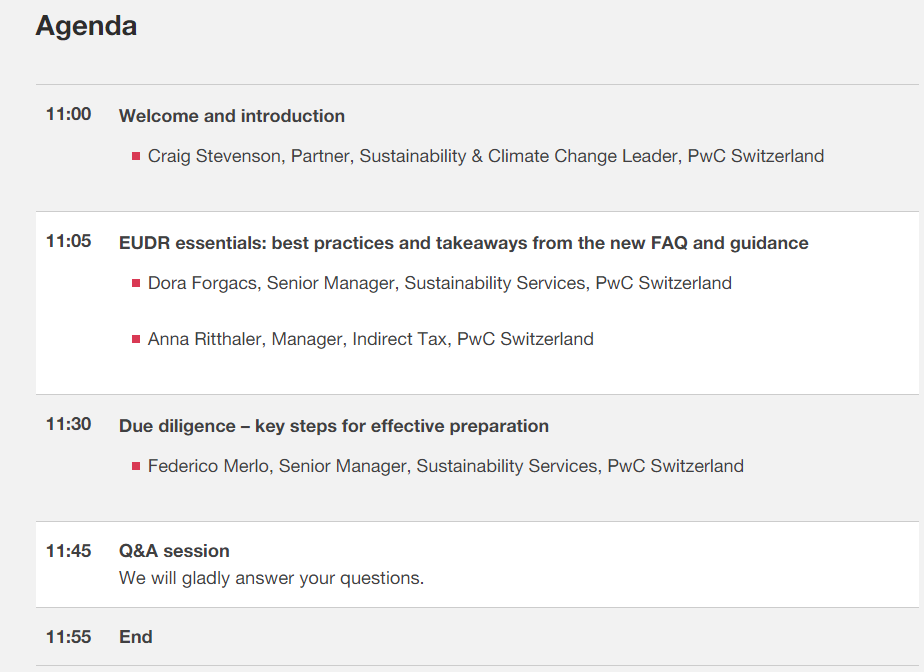
Exploring the latest developments and essential insights for compliance with EUDR
About the event
Join our upcoming webinar for an in-depth exploration of the EU Deforestation Regulation (EUDR).
We’ll provide overview of the regulation and insights into the latest updates, including reporting requirements and their alignment with other sustainability and regulatory obligations. Drawing on our real-life project experience, we will also discuss use cases and practical industry strategies to meet compliance challenges.
As a student, I worked in Norway – a beautiful country. One day, I was out with my Norwegian colleagues when one suddenly said, “Look, there’s our king,” nodding toward an elderly man walking alone across the street. At first, he didn’t look like a king at all – perhaps I had a somewhat naive idea of royalty back then. But most surprising was that he was walking completely alone. I’m not sure if something like this would still happen in Oslo today. In Switzerland, though, you can still encounter a Federal Councillor or, more often, a former Councillor, casually going about their day alone.
For example, a former Councillor lives in our building. A very kind gentleman. We often meet at the mailbox, in the elevator, or in the stairwell. It feels good to feel safe. I feel safe in Switzerland – why wouldn’t I? Many young children here go to kindergarten all by themselves. I can’t think of a single place in Switzerland where I’ve felt afraid. It’s perhaps wise to avoid Oerlikon station between 1 and 4 a.m. on weekends to steer clear of conflicts with drunk or otherwise impaired individuals. But the truth is, if I had to be at Oerlikon station at that time, I’d feel a sense of respect, but not fear. This sense of security, which seems so natural, is truly a valuable gift.
As a young student, I lived in a different country, in a run-down area where, alongside many wonderful people, a few strange characters also lived. If I had to go home in the dark, I often felt uneasy. So, I decided to arm myself. A weapon is useless if one isn’t ready to use it in an emergency. Willingness alone isn’t enough – you have to be able to defend yourself. The only weapon I can handle well is a fencing foil. So, I began carrying a silver foil, like a musketeer. My foil wasn’t sharp, and the tip was rounded. Injuring someone with it would only be possible if the blade broke. Still, my foil gave me a sense of security, and I walked without fear, even at night, in that neighborhood. Only once did a near-incident occur.
I was returning home around 8 p.m. in winter, and it was already pitch-dark. The light in the corridor of our building wasn’t working well, as usual. I couldn’t see much when a shadow suddenly appeared. Someone had been hiding in the darkness near my apartment door. A shiver ran through me, and my adrenaline spiked. All possible options flashed through my mind in a split second. I could scream loudly, though in this building, it probably wouldn’t have caught much attention – there was constant shouting from arguments or drunken cries. I could run, but where to and with what result? So, I chose my foil and immediately prepared to defend myself.
Then, the shadow suddenly said “Boo,” and I recognized the voice of my foolish friend David. He’d wanted to scare me, and it was a close call – I might have seriously hurt him. What a silly prank! He frequently made inappropriate jokes like this. He’d actually been waiting for me because he was feeling down and wanted to talk. Why someone in distress would make jokes is beyond me.
I know what it’s like to feel afraid when walking alone, and I deeply appreciate not having to feel that way anymore. Thank you, Switzerland.
Als Studentin habe ich in Norwegen gearbeitet. Ein wunderschönes Land. Eines Tages war ich mit meinen norwegischen Kollegen unterwegs, als einer plötzlich sagte: „Sieh mal, unser König,“ und mit dem Kopf in Richtung eines älteren Herrn nickte, der ganz allein auf der anderen Straßenseite ging. Zum einen sah dieser Mann überhaupt nicht aus wie ein König – vielleicht hatte ich damals eine ziemlich naive Vorstellung von Königen. Und zum anderen war er völlig allein unterwegs. Ob so etwas heute in Oslo noch möglich wäre, weiß ich nicht. In der Schweiz kann es durchaus vorkommen, dass man einem Bundesrat oder, noch häufiger, einem ehemaligen Bundesrat einfach so auf der Straße begegnet.
Zum Beispiel wohnt ein ehemaliger Bundesrat bei uns im Haus. Ein sehr netter Herr. Wir treffen uns oft am Briefkasten, im Aufzug oder im Treppenhaus. Es ist ein gutes Gefühl, sich sicher zu fühlen. In der Schweiz fühle ich mich sicher – warum auch nicht? Viele Kinder gehen hier schon früh ganz allein in den Kindergarten. Mir fällt auch keine einzige Gegend in der Schweiz ein, in der ich jemals Angst gehabt hätte. Es ist vielleicht ratsam, den Bahnhof Oerlikon am Wochenende zwischen 1 und 4 Uhr morgens zu meiden, um Konflikten mit Betrunkenen oder anderweitig beeinträchtigten Personen aus dem Weg zu gehen. Aber die Wahrheit ist, dass ich, selbst wenn ich um diese Zeit am Bahnhof Oerlikon sein müsste, großen Respekt, aber keine Angst hätte. Dieses Sicherheitsgefühl, das so selbstverständlich erscheint, ist ein Geschenk von großem Wert.
Als junge Studentin lebte ich noch in einem Land, in einem heruntergekommenen Viertel, wo neben vielen tollen Menschen auch einige merkwürdige Gestalten unterwegs waren. Wenn ich im Dunkeln nach Hause musste, fühlte ich mich oft unwohl. Also beschloss ich, mich zu bewaffnen. Eine Waffe bringt jedoch nichts, wenn man nicht bereit ist, sie im Notfall auch einzusetzen. Allein der Wille reicht nicht – man muss in der Lage sein, sich tatsächlich zu verteidigen. Die einzige Waffe, die ich wirklich beherrsche, ist der Degen. Also begann ich, einen silbernen Degen wie ein Musketier mit mir zu tragen. Mein Degen war nicht scharf, und die Spitze war abgerundet. Jemanden damit zu verletzen wäre wohl nur möglich gewesen, wenn die Klinge gebrochen wäre. Dennoch gab mir mein Degen ein Gefühl von Sicherheit, und ich bewegte mich ohne Angst auch nachts in diesem Viertel. Nur einmal kam es beinahe zu einem Unfall.
Es war etwa 20 Uhr an einem Winterabend, stockdunkel, und das Licht im Hausflur funktionierte wieder einmal nicht richtig. Ich konnte kaum etwas erkennen, als plötzlich ein Schatten auftauchte. Jemand hatte sich im Dunkeln an meiner Wohnungstür versteckt. Ein Schreck durchfuhr mich, und mein Adrenalinspiegel schoss in die Höhe. Alle möglichen Optionen gingen mir in einem Bruchteil einer Sekunde durch den Kopf: Ich hätte laut schreien können, doch in diesem Haus hätte das wohl kaum jemanden interessiert, denn ständig stritt hier jemand oder schrie im Rausch herum. Ich hätte weglaufen können – doch wohin und mit welchem Ergebnis? Also entschied ich mich für meinen Degen und bereitete mich sofort darauf vor, mich zu verteidigen.
Da sagte der Schatten plötzlich „Baff“ – und ich erkannte die Stimme meines idiotischen Kollegen David. Er wollte mich erschrecken, und es fehlte nicht viel, und ich hätte ihn womöglich ernsthaft verletzt. Ein dämlicher Witz! Solche unpassenden Scherze machte er ständig. Dabei hatte er Kummer und wollte mit mir sprechen. Warum jemand, der Kummer hat, solche Witze macht, verstehe ich bis heute nicht.
Ich weiß, was es bedeutet, allein unterwegs Angst zu haben, und ich schätze es, heute keine Angst haben zu müssen, wenn ich allein unterwegs bin. Danke, Schweiz.
Starting 1 January 2025, a revision of the Swiss VAT Act will be implemented and will bring certain changes. Below is an overview of the most important updates that you should be aware of:
Platforms: New VAT Rules for Digital Platforms
The revised VAT Act will introduce significant modifications impacting digital platforms. One of the key changes is that the VAT registration obligation will shift from the supplier to the platform. Platforms will be required to act as “deemed suppliers”, register for Swiss VAT, and charge, collect, and remit Swiss VAT on all subsequent supplies of goods.
The “deemed supplier” concept will apply to both cross-border and domestic supplies, where two separate transactions will be deemed to have taken place under certain conditions:
Supply from the supplier to the platform – without Swiss VAT:
Domestic supplies: VAT exempt (with the right to deduct input VAT)
Cross-border supplies to Switzerland: place of supply abroad, no Swiss VAT
Supply from the platform to the end customer:
Domestic supplies: subject to Swiss VAT
Cross-border supplies to Switzerland: import Swiss VAT (generally) + local Swiss VAT on the supply to the end customer (whether B2C or B2B)
The resulting VAT implications for the marketplace operator/platform as of 2025 are as follows:
VAT registration for the platform is required if the marketplace operator’s turnover from low-value consignments from abroad exceeds CHF 100,000 per year (or, in the case of domestic supplies in Switzerland, if worldwide turnover exceeds CHF 100,000 per year).
If turnover from low-value consignments from abroad exceeds CHF 100,000 per year, the place of supply is deemed to be in Switzerland and all subsequent supplies of goods from abroad to end customers in Switzerland, regardless of the value, are subject to Swiss VAT. The platform must act as the importer of record and charge Swiss VAT to Swiss customers (even if no import VAT was due for the relevant low-value consignments).
Reporting & Declarations: Simplified Processes for Annual Declarations
Until now, companies had the flexibility to file VAT returns quarterly, semi-annually, or monthly. As of 1 January 2025, businesses with annual revenues of up to CHF 5,005,000 can opt to file VAT returns annually.
Adjustments to VAT Exemptions
Certain adjustments have also been made regarding VAT exemptions. New VAT exempted services are (these are generic description that need to be analyzed in further detail on a case-by-case basis):
Travel services resold by domestic and foreign travel agencies, along with their related services. (Foreign travel agencies will not be liable for tax in Switzerland when organizing trips to Switzerland);
Active participation in cultural events;
Coordinated care services provided during medical treatments;
Provision of infrastructure for attending physicians in outpatient and day clinics;
Care and domestic services provided by private home care organizations;
Provision of staff by non-profit organizations;
Offering and management of Swiss Investment Foundations.
Emission rights and green certificates
The VAT revision shifts the identity of the VAT-liable person when it comes to emission rights (green certificates and similar rights and certificates). From 1 January 2025, the recipient of such certificate will have to apply reverse charge on such acquisitions (whether the provider is domiciled in Switzerland or abroad).
Tax rate changes for feminine hygiene products
Feminine hygiene products are now subject to the reduced VAT rate (2.6%).









 Michaela Merz